Transport-window RFQ inputs

InputRequired project information
Window and glazingDrawing revision, visible area, mask, glass stack and emergency sightlines
MechanicalMounting zone, allowable depth, mass, cable exits and service route
ElectricalVehicle supply range, protection, grounding, controller location and interfaces
EnvironmentTemperature, EMC, shock, vibration, vehicle category and operating duty
ProgramPrototype quantity, validation ownership, pilot build and SOP target

A credible quotation for a transport window display cannot be based on diagonal, quantity and target price alone. The display becomes part of a vehicle window assembly, power network, data architecture, passenger environment and maintenance system. Until those interfaces are defined, the bidder can price only assumptions.

The most important RFQ document is therefore the vehicle interface baseline: the controlled set of drawings, operating conditions, responsibilities and validation requirements against which the proposed assembly will be engineered.

If the baseline changes after quotation — glass construction, visible mask, cable exit, supply behavior, test category or service route — the quotation and validation scope must be reviewed.

Define the use case and authority structure first

State what the display is expected to do and which organization controls each affected vehicle function.

Typical use cases include passenger information, route and interchange guidance, advertising, accessibility information, driver or staff communication and transparent digital overlays that preserve an exterior view. Each creates different priorities for readability, content assurance, operating states and sightlines.

Identify at least:

  • vehicle manufacturer or integrator;
  • operator and maintenance organization;
  • glazing and window-system authority;
  • electrical and EMC authority;
  • vehicle network or data-interface authority;
  • fire, materials and safety authority;
  • content and cybersecurity owner;
  • test laboratory and acceptance authority.

The display-system provider cannot resolve conflicts between these domains after hardware has been built. Requirements and sign-off responsibility must be assigned before design release.

Release a controlled window and vehicle geometry package

The RFQ should include the current window drawing and vehicle interface model, with revision and datum. Define:

  • clear opening, glass outline and curvature;
  • glass construction and accountable glazing manufacturer;
  • permitted active display area and obscuration mask;
  • passenger and exterior viewing directions;
  • emergency, driver or staff sightlines that must remain clear;
  • allowable installation depth on each side of the glazing;
  • mounting points, load limits and tolerance stack;
  • maximum assembly mass and center-of-gravity constraints;
  • nearby trim, seals, blinds, doors, handrails and moving mechanisms;
  • cable entry and exit zones;
  • service access and removal envelope;
  • drainage, condensation and cleaning conditions;
  • acceptable appearance when the display is dark, off or failed.

A visual concept pasted over a window elevation is not a mechanical interface. The quotation should identify exactly which parts are display, protective glass, mask, frame, controller, cable and vehicle-supplied structure.

Separate display glass from vehicle safety glazing

Do not assume that the display head can replace the vehicle’s certified window construction. In many concepts, the display is integrated behind or within a glazing assembly whose structural, impact, fragmentation, fire and optical requirements remain controlled by the vehicle and glazing authorities.

The RFQ must state:

  • whether the display sits inboard, outboard or within a laminated stack;
  • who designs and releases the glazing assembly;
  • whether optical bonding is permitted;
  • the protective layer and cleanable passenger surface;
  • allowable reflection, haze, distortion and color shift;
  • how the assembly behaves if the display or protective layer is damaged;
  • which tests apply to the glass, display and installed assembly respectively.

Adding commercial protective glass does not create transport qualification. Conversely, a qualified window does not automatically qualify electronics attached to it.

Define the full power interface

Nominal vehicle voltage is not enough. Provide the project-defined supply envelope and the applicable electrical requirements at the display connection.

The input package should define:

  • nominal and permitted continuous input range;
  • transients, interruptions, brownout and recovery conditions;
  • inrush and start-up sequencing constraints;
  • available power, branch protection and connector;
  • isolation, bonding and earthing requirements;
  • shutdown signal or ignition state if applicable;
  • maximum heat rejected into the vehicle zone;
  • behavior after power loss and restoration;
  • low-voltage or degraded operating state;
  • power measurement and acceptance method.

For rail rolling stock, IEC 60571:2012 addresses electronic equipment used on rolling stock, including supply, environmental and reliability-related aspects within its scope. It is not a substitute for the vehicle project’s electrical interface specification or for qualification of the final assembly.

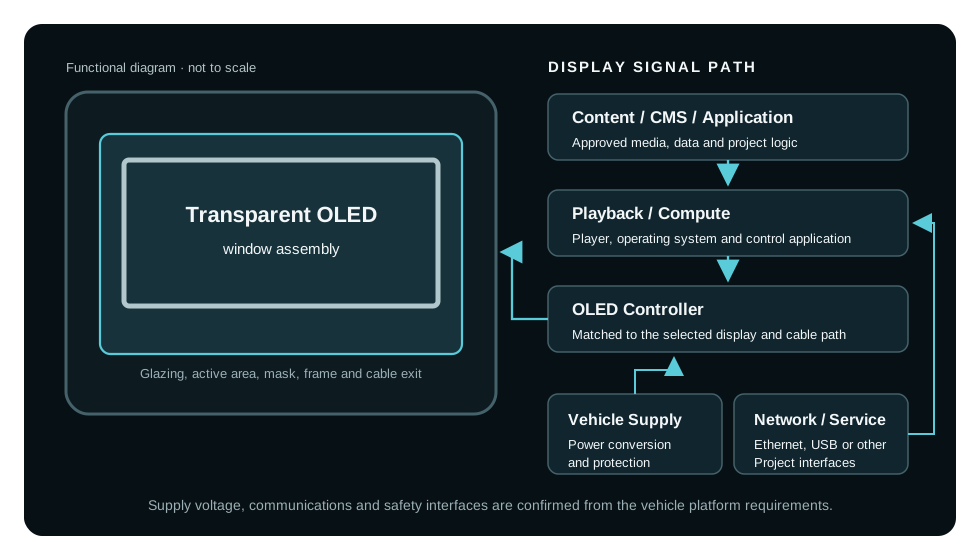
Define data, control and content assurance

State whether the display receives scheduled media, passenger-information data, a rendered video signal or a combination. Then define the system boundary.

Required inputs can include:

  • source system and data owner;
  • protocol, physical interface and message definition;
  • player or compute location;
  • operating system or firmware image;
  • network topology and cybersecurity controls;
  • time synchronization;
  • local cache and offline content;
  • update and rollback method;
  • monitoring, logs and alarm outputs;
  • approved fallback image or blank state;
  • behavior with invalid, late or unavailable data;
  • content language, accessibility and safety priority rules.

If advertising and passenger information share the same surface, define which function has priority and what appears during loss of communications. The visible failure state is a system requirement, not a creative afterthought.

Specify the actual environment and mounting location

Environmental requirements depend on where and how the assembly is mounted. Provide the project values and test categories rather than requesting generic “railway grade”.

Relevant conditions can include:

  • operational and storage temperature;
  • solar load through the window;
  • local heating and cooling airflow;
  • humidity, condensation and water ingress;
  • dust and cleaning chemicals;
  • vibration and shock mounting category;
  • passenger impact, tampering and cleaning loads;
  • electromagnetic environment and cable routing;
  • altitude and pressure where applicable;
  • acoustic limits for fans or moving parts;
  • fire and smoke requirements for all added materials.

The display’s own temperature sensor does not establish the thermal environment of a laminated or enclosed window assembly. Use measured vehicle data or an agreed thermal boundary model, then validate the representative construction.

Use railway standards with the correct scope

Several IEC publications may be relevant to a rail project, but they do not form one universal “display certification”.

PublicationRelevant scope in this contextWhat the RFQ must still define
IEC 60571:2012electronic equipment used on rolling stockequipment boundary, supply conditions, project deviations and evidence
IEC 61373:2026shock and vibration tests for rolling-stock equipmentmounting category, location, fixture, mass and representative test article
IEC 62236-3-2:2018EMC requirements for apparatus on rolling stockports, cable configuration, operating modes, performance criteria and vehicle context
IEC 61991:2019protection against electrical hazards associated with railway installationsapplicability to the vehicle/system and allocation of protective measures

IEC 61373:2026 replaced the 2010 edition in July 2026. The selected edition, contractual transition rules and compatibility with the wider vehicle evidence set must be agreed by the project.

For EMC, IEC 62236-3-2 is the specific part for rolling-stock apparatus. Citing only IEC 62236-1, the general part of the series, is not a sufficient EMC requirement for the equipment.

Bus, road-vehicle and some tram applications may use different regulatory and contractual frameworks. Do not copy a rail standards list into a bus RFQ without an applicability review.

Define the representative test article

Qualification evidence is valid only for a defined configuration. Record:

  • display model and revision;
  • protective glass, bonding and frame;
  • controller, power conversion and enclosure;
  • representative cable types, lengths, shielding and termination;
  • software and firmware versions;
  • mounting points and test fixture;
  • operating mode and test content;
  • sensors, network interfaces and peripheral devices;
  • mass and center of gravity;
  • permissible substitutions.

Testing a bare commercial display does not qualify the integrated assembly. Testing an assembly with laboratory cables may not represent the installed EMC configuration. Testing a non-operating unit may not exercise the highest-emission or highest-power state.

Allocate validation ownership

The quotation should contain a responsibility matrix.

ActivityDisplay-system providerVehicle integratorGlazing manufacturerLaboratory/authority
Product data and controlled BOMownreviewinput where relevantwitness if required
Vehicle geometry and interfacesreviewowncontribute
Integrated glass/frame designcontributeapproveown or co-owntest as specified
Power and data interfacedesign to inputown vehicle boundaryverify as specified
EMC configurationprepare equipmentdefine vehicle contextcontribute conductive partsexecute/report
Shock/vibration fixtureprovide assembly dataapprove boundarycontributeexecute/report
Vehicle installation and route trialsupportownsupportauthority accepts

The final matrix will be project-specific. Its purpose is to prevent gaps such as each party assuming another party will qualify the integrated glass/display assembly.

Plan prototype, pilot and production gates

Use staged evidence:

Engineering prototype

Confirms visible area, background interaction, content readability, packaging, controller position, power concept, thermal risks and service route. It may not yet be a qualification article.

Qualification article

Represents the released or agreed qualification configuration. Changes after testing are assessed for impact and may require partial or full re-test.

Vehicle pilot

Confirms installation tolerances, actual cable routes, vehicle power, network integration, reflections, cleaning, passenger sightlines and maintenance procedure.

Production release

Freezes approved drawings, BOM, software, configuration, inspection criteria, test evidence, approved deviations and change-control ownership.

A sample that plays a video in the laboratory is evidence of concept, not evidence of production readiness.

Minimum RFQ input package

Before requesting a firm quotation, provide:

  1. vehicle type, fleet program, country and project stage;
  2. use case, audience and required information priority;
  3. controlled window and interface drawings;
  4. glass construction and glazing responsibility;
  5. active area, mask, sightlines and display-off requirement;
  6. mechanical envelope, loads, mounting and service route;
  7. power-interface specification and available budget;
  8. data, player, network and control architecture;
  9. environmental, EMC, shock/vibration, fire and material requirements;
  10. applicable editions, categories, levels and acceptance authority;
  11. prototype, qualification, pilot and production quantities;
  12. required reports, language, schedule and target start of production.

Where data is not yet available, mark it as open and identify who will close it. Do not hide an unknown behind a generic compliance statement.

Primary references

  • IEC 60571:2012 — electronic equipment used on rolling stock.
  • IEC 61373:2026 — rolling-stock shock and vibration testing; current edition at the audit date.
  • IEC 62236-3-2:2018 — EMC requirements for apparatus on rolling stock.
  • IEC 61991:2019 — protection against electrical hazards associated with railway installations.

Scope note

This article is an RFQ-development framework, not a compliance declaration. Applicability, editions, categories, test levels, performance criteria and evidence must be defined and accepted by the accountable vehicle and regulatory authorities for the actual project.

Project checklist

Related product and project pages