Verified transparent-display routes
| Reference | Published product class | What it means for a project |
|---|---|---|
| LG 30EW5TP-A | 30-inch commercial transparent OLED touch signage; 1,366 × 768; 37% published display transparency | Indoor 18/7 moving-content operation; validate the enclosure, scene, controller and service route |
| LG 55EW5Q-C | 55-inch commercial transparent OLED signage; 1,920 × 1,080; 43% published display transparency | Indoor 18/7 moving-content operation; validate glazing, cable exit, background and service access |
| LG OLED77T4PUA | 77-inch consumer 4K transparent OLED television | Do not treat it as an open-frame commercial signage equivalent; review the self-contained TV product and operating profile |
| BOE BTX-TP | A transparent LED product class with model-dependent spacing and transmittance | Compare released products for larger window and spatial-media applications; do not equate LED transmittance with OLED transparency |
Transparent OLED is the right technology only when the real scene behind the display is part of the experience. If the object, person, view or architecture behind the display adds no value, a conventional OLED, LCD or direct-view LED solution may deliver stronger contrast, simpler integration and lower project risk.
The first decision is therefore not 30 inches versus 55 inches. It is whether the project can create a useful optical composition in which emitted content and the transmitted background remain legible together.
Qualify the application, lighting, viewing geometry, content, glazing, operating duty and service route first. Then choose a commercial display format and build a representative prototype.
The transparency question comes second
A published transparency percentage does not describe the finished installation. It is a product-level value measured under the manufacturer’s conditions. Protective glass, optical films, bonding, air gaps, surface reflections, masks, frame coverage and the brightness of the background all change what the viewer experiences.
Start with six questions:
- What physical subject or view must remain visible?
- What digital information must be read, and from which positions?
- Can the front and rear lighting be controlled?
- Is the display exposed to direct sun, exterior weather or severe reflections?
- What should the installation look like when content is dark or the display is off?
- Can the controller, cables, ventilation and service access be integrated honestly?
If those questions have no clear answers, comparing product transparency figures is premature.
Identify the application mode
Transparent OLED projects usually fall into one of four modes.
Object overlay
The display adds labels, callouts or animation over a product, artifact or model. This is effective when object lighting, background depth and viewer position are controlled. The content should reinforce the physical subject rather than cover it.
Human interaction across the display
The display sits between a visitor and a member of staff, or forms part of a touch interface. Eye contact, facial visibility, touch reach, privacy, camera placement and accessibility become system requirements.
Architectural or window layer
Digital information appears over an interior or exterior view. The larger and brighter the uncontrolled scene, the more difficult it becomes to maintain content contrast. Reflections, changing daylight and the visible controller/cable route may dominate the result.
Transformable opaque/transparent scene
A controlled backing, lighting change or mechanical state can produce a stronger content mode and a more open transparent mode. This can be visually powerful, but it adds control, synchronization, failure-state and service requirements.
Each mode needs a different prototype. A tabletop demo against a black studio background cannot approve a daylight-facing architectural installation.
Decide whether transparent OLED is the correct class
Transparent OLED is strongest when viewers are relatively close, the physical background matters, fine graphics or text are required and the scene can be controlled. It becomes weaker when the installation requires very large continuous areas, high daylight readability, exterior exposure or long-distance viewing.
Transparent LED is a separate architecture that may suit larger window or spatial media surfaces. BOE’s current MLED platform, for example, lists transparent products with model-dependent transmittance and spacing. Those values are not directly interchangeable with OLED display-transparency values because the optical structures and measurement contexts differ.
Projection and transparent projection films can be useful in other controlled-light applications. Conventional opaque displays remain the correct answer when transparency does not create functional or experiential value.
The goal is not to prove that transparent OLED can be installed. The goal is to determine whether it is the lowest-risk technology that fulfils the experience.
Compare the current 30- and 55-inch commercial formats
LG currently publishes two relevant commercial transparent OLED formats for this comparison.
| Published product | 30EW5TP-A | 55EW5Q-C |
|---|---|---|
| Diagonal | 30 inch | 55 inch |
| Native resolution | 1366 × 768 | 1920 × 1080 |
| Published display transparency | 37% | 43% |
| Published luminance | 200 cd/m² at APL 100%; 600 cd/m² at APL 25%, without glass | 200 cd/m² at APL 100%; 600 cd/m² at APL 25%, without glass |
| Touch | Integrated PCAP touch published | No integrated touch published; any touch assembly is project-specific |
| Commercial use condition | Indoor; 18/7; moving content only | Indoor; 18/7; moving content only |
| Typical integration direction | Counter, compact showcase, assisted-information or touch interface | Larger showcase, partition, museum, retail or architectural assembly |
The table does not select the product. The 30-inch format may be easier to integrate into an interactive counter, but its pixel canvas and active area limit content. The 55-inch format creates a larger overlay but requires a larger controlled scene and careful integration of the separate electronics, cables, glass and structure.
Always confirm the current regional datasheet and support documentation before quotation. Product availability, included accessories and approved operating conditions can vary by market.
Read luminance as a content-dependent product value
LG publishes 200 cd/m² at APL 100% and 600 cd/m² at APL 25% for both referenced products, measured without glass. APL is the average picture level of the frame; it is not simply a promise that any graphic occupying one quarter of the screen will always produce 600 cd/m² in the final installation.
Sparse highlights, dense white layouts and full bright fields load the OLED image differently. Protective glazing and reflections then affect the viewer’s contrast. For that reason, product luminance cannot be converted directly into an installed-readability prediction.
Prototype at least:
- the densest bright composition;
- the normal content loop;
- fine text over the brightest background zone;
- the darkest intended content state;
- the brightest expected ambient and background condition.
Approve the full scene, not a specification value in isolation.
Treat black correctly
Black and near-black content contributes little or no emitted OLED light, so more of the transmitted scene can be visible through those image areas. The display does not become optically absent. Its substrate, electrodes, surface, protective glass, reflections and any contamination remain visible.
This distinction affects creative expectations. A black full-screen image is not the same as removing the display. The display-off state should be photographed and approved under representative front and rear lighting.
Design the optical and mechanical stack together
The finished view is created by more than the OLED display head. Define:
- protective-glass type, thickness and surface treatment;
- air gap, bonding or retention method;
- mask and frame coverage;
- front and rear reflections;
- permitted cleaning method and chemical exposure;
- touch overlay if required;
- display datum, tolerance and visible active area;
- controller and power-supply location;
- cable exit, bend radius, strain relief and replacement route;
- heat path and ventilation;
- access for service without damaging the glass assembly.
Do not conceal the electronics in an inaccessible cavity simply to preserve the concept rendering. The installation must remain serviceable after surrounding joinery or glazing is complete.
Exclude unsuitable environments early
The cited 55EW5Q-C specification publishes operating-temperature and humidity limits, but no outdoor, ingress-protection or direct-sunlight rating. An exterior-facing window can create high ambient light, heat and reflections even when the display itself remains inside the building.
Projects involving direct sun, outdoor exposure, uncontrolled heat, condensation, severe vibration, impact risk or safety glazing require a separate technology and assembly assessment. Adding protective glass does not automatically convert an indoor product into an outdoor- or transport-qualified system.
For vehicles, public spaces or regulated installations, the installed assembly may require application-specific mechanical, electrical, EMC, material and safety evidence. A commercial display datasheet does not certify that assembly.
Respect the published operating duty
LG lists 18/7 operation with moving content only for the 30EW5TP-A and 55EW5Q-C. The content and scheduling plan must respect that published product condition.
Do not approve an interface containing permanently static logos, borders, navigation bars or status elements merely because the background video changes. Define how persistent elements move, alternate, dim or clear, and define the daily off period. If the application requires 24/7 operation or long-duration static information, qualify a different product or operating concept rather than assuming equivalence.
Build a representative prototype
The prototype should reproduce the risk, not just the product.
Include:
- the selected 30- or 55-inch commercial display;
- representative protective glass and optical stack;
- actual or simulated physical background;
- front, object and rear lighting at key operating levels;
- nearest, primary and oblique viewer positions;
- released controller and playback path;
- intended cable exit and mechanical mask;
- normal, stress and display-off content states;
- touch, sensor or backing control where applicable;
- a credible service-access demonstration.
Record the approved settings and scene. A prototype accepted in a dark meeting room is not evidence for a bright retail window unless the difference has been quantified and reviewed.
Use explicit acceptance criteria
Acceptance should cover more than “looks good”. Agree:
- critical text and graphic readability from defined positions;
- visibility of the required physical subject;
- reflection and glare limits by agreed observation or measurement method;
- appearance in normal, bright-background, dark-background and off states;
- color and brightness presets;
- touch or sensor behavior and return-to-idle state;
- content scheduling consistent with operating duty;
- start-up, signal-loss and power-recovery behavior;
- cleaning, access and replacement procedure;
- approved mechanical and software configuration.
The exact thresholds are project-specific. The important point is to define them before the product and integration concept are released.
What about the 77-inch LG SIGNATURE OLED T?
LG presents OLED77T4PUA as a 77-inch consumer 4K television with a retractable black shade and Zero Connect Box. It can be relevant to premium residential or hospitality concepts as a self-contained consumer product. It is not an open-frame commercial-signage equivalent to the 30EW5TP-A or 55EW5Q-C.
Do not include it in the same commercial format comparison without separately reviewing its enclosure, operating profile, control, support, mounting, service and regional availability. A creative approval on OLED T does not approve content or integration for the commercial transparent OLED products.
Information required for a useful quotation
Provide:
- application and desired interaction with the physical scene;
- target active area and orientation;
- drawings and available mechanical depth;
- viewer positions and required information;
- background materials, depth and lighting;
- maximum ambient light and any direct-sun exposure;
- protective glass, touch and cleaning requirements;
- content examples and expected static elements;
- daily schedule and required service life;
- controller, power, player and cable locations;
- network, CMS and control requirements;
- quantity, country, project stage and validation expectations.
With those inputs, VITREVIA can determine whether transparent OLED is appropriate, which commercial format deserves a prototype and what must be engineered around it.
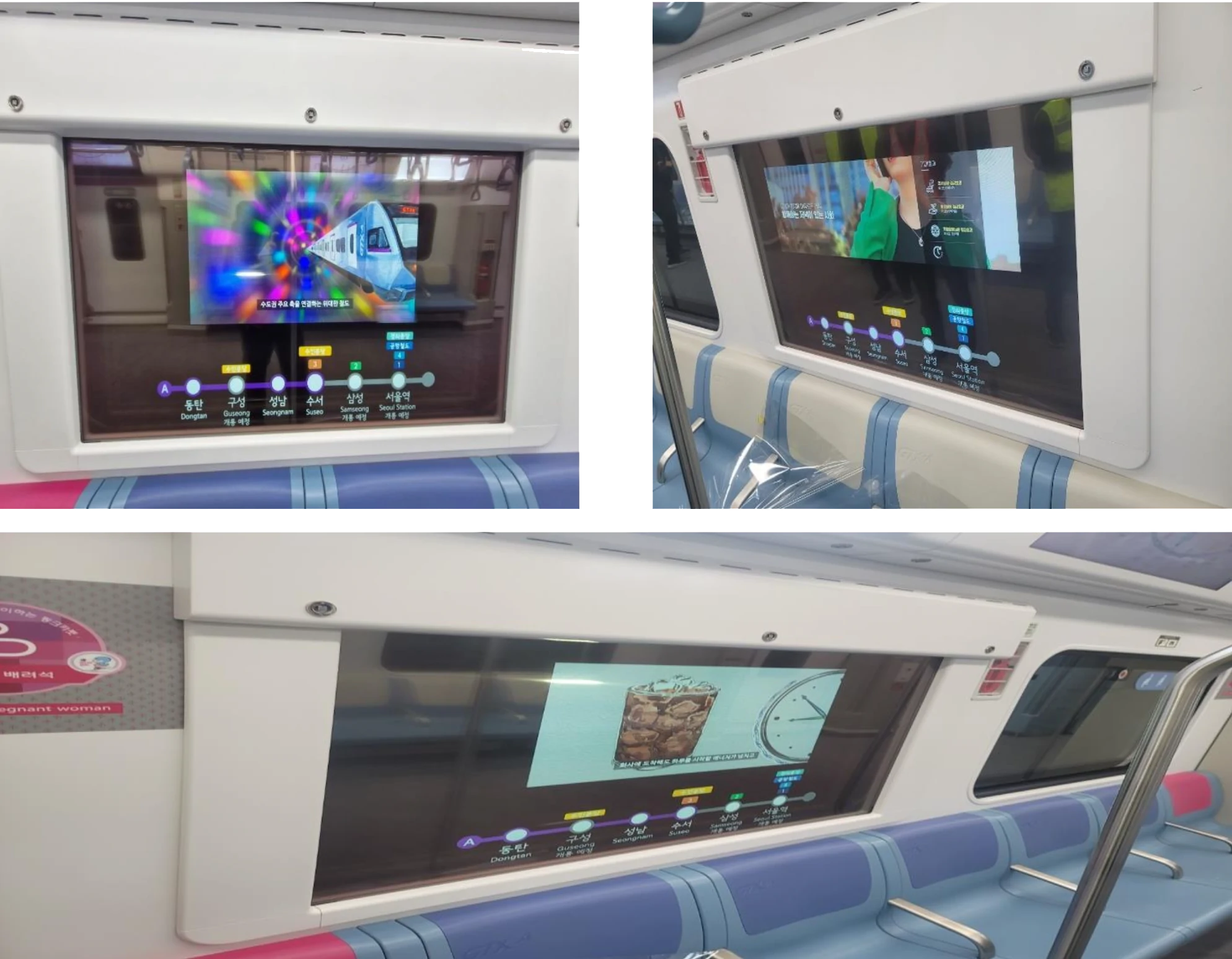
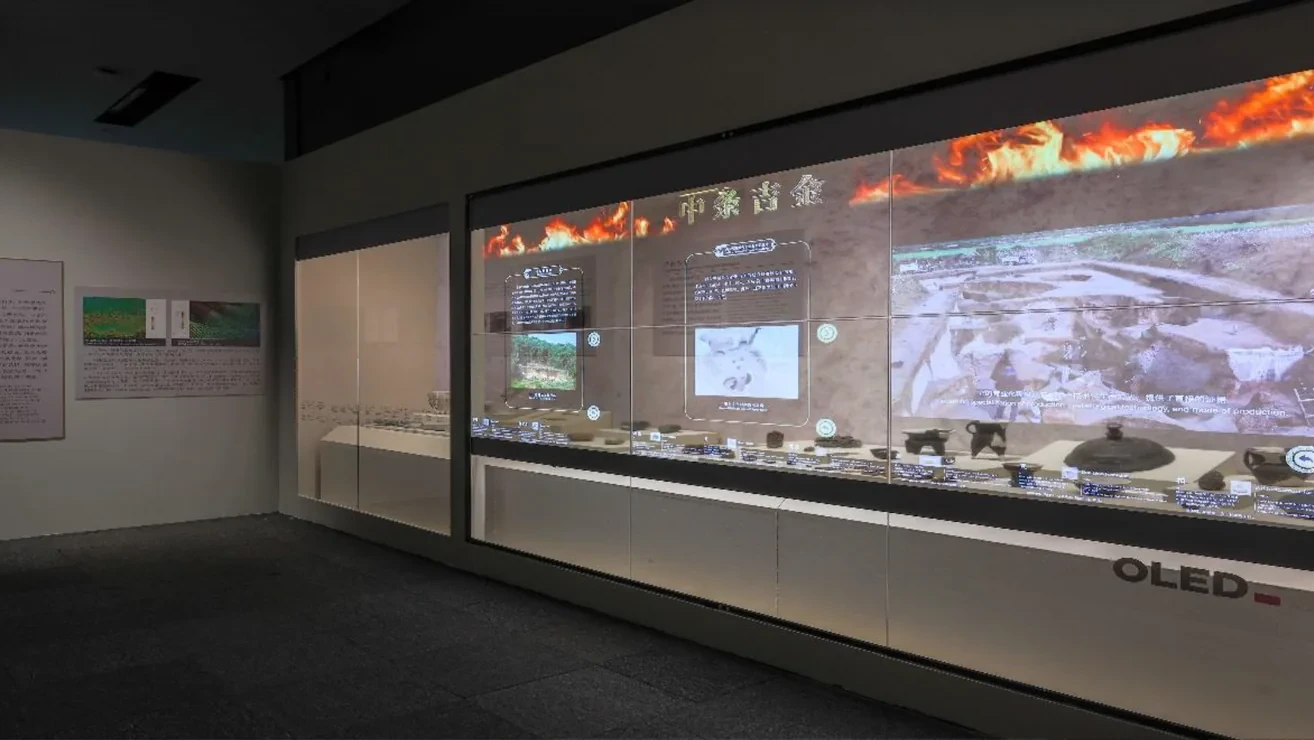
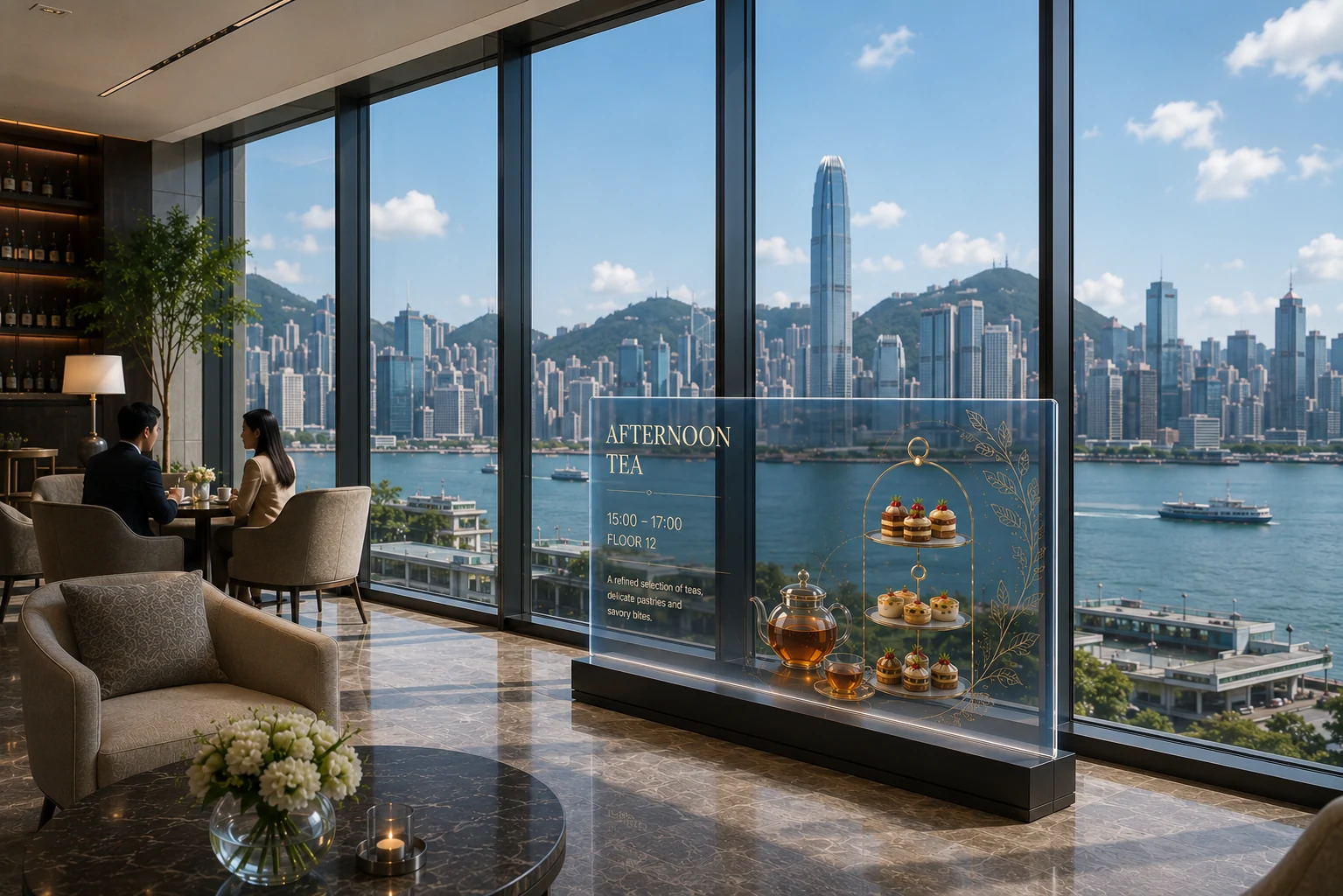
Four application views to test before engineering
These VITREVIA concept visualizations show the intended application context; they are not installed-project claims. Each scene should be recreated with the selected display, real background, lighting and representative content during project validation.
Transportation
Passenger information layered over a real window view. Sightlines, display-off visibility, glass, vehicle interfaces and service access become part of the system.
Museum interpretation
Digital labels and narrative content positioned with the real artifact. Object lighting, reflections and visitor distance must be tested together.
Luxury retail
Product storytelling without hiding the physical object. Background control, content density and the customer viewing path determine the visual result.
Premium interiors
Guest information integrated into an open interior. The installation must coordinate furniture, lighting, cabling, content and the display-off state.
Transparent OLED project FAQ
What is the difference between 30-inch and 55-inch transparent OLED?
The LG 30EW5TP-A is a 30-inch commercial touch display with 1,366 × 768 resolution, 37% published display transparency and native PCAP touch. The LG 55EW5Q-C is a 55-inch commercial signage display with 1,920 × 1,080 resolution and 43% published display transparency; touch requires a separate project-specific assembly.
Does 43% transparency mean the finished installation transmits 43% of the light?
No. LG publishes 43% for the 55EW5Q-C display set. Protective glazing, optical films, bonding, reflections, the frame and the scene behind the display change the optical result of the installed system.
Can transparent OLED be used in bright daylight or outdoors?
The 30EW5TP-A and 55EW5Q-C references are indoor commercial products. Readability must be tested with the intended ambient light, background and glazing. Outdoor, direct-sunlight or high-ambient-light projects require a separate technology and environmental review.
Is the 77-inch LG SIGNATURE OLED T a commercial signage product?
No. LG presents OLED77T4PUA as a 77-inch consumer 4K television with a retractable black shade and Zero Connect Box. Its consumer product class, enclosure and operating profile must not be treated as equivalent to a 30- or 55-inch commercial transparent OLED signage product.
When should transparent LED be compared with transparent OLED?
Transparent LED is a separate architecture worth comparing when the project calls for a larger modular window or spatial media surface. BOE describes BTX-TP as a transparent LED product for retail windows and automotive showrooms. Its transmittance and mechanical figures are product-specific and are not directly interchangeable with OLED transparency values.
What information is needed for a transparent OLED quotation?
Share the application, target visible area, orientation, viewer positions, background, ambient light, glazing, content goal, touch or sensor needs, controller location, cable route, operating duty, quantity, country and project stage. Drawings or specifications can be attached when available.
Primary references
- LG 30EW5TP-A commercial transparent OLED — current product class and published product data.
- LG 55EW5Q-C commercial transparent OLED — current product class and published product data.
- LG 55EW5Q-C specification sheet — luminance conditions, operation and integration-related specifications.
- LG Transparent OLED applications — manufacturer application context.
- BOE MLED product platform — current transparent LED product category and model-dependent platform data.
Scope note
Product values above are attributed to the named products and should be reconfirmed for the purchasing region and released revision. The qualification flow, prototype scope and acceptance framework form part of VITREVIA’s project-development framework.
Project checklist
Related product and project pages
Transparent OLED Systems
Review commercial transparent OLED formats, product data and integration packages.
Review Transparent OLED SystemsTransportation
See transparent display concepts for passenger windows and mobility interiors.
Explore TransportationMuseum & Culture
See interpretation displays that keep real objects and collections visible.
Explore Museum & CultureLuxury Retail
See transparent product storytelling and hospitality display concepts.
Explore RetailRelated Display Guide
Continue with the complementary display-system engineering guide.
Read the Related GuideProject Requirements
Organize geometry, environment, content, operation and service inputs for engineering review.
Build the Project Brief