
Transparent OLED for Museums, Retail, Hospitality and Architecture
Order a transparent OLED product or integrated spatial display package for museum interpretation, retail showcases, hospitality, offices and interactive information.
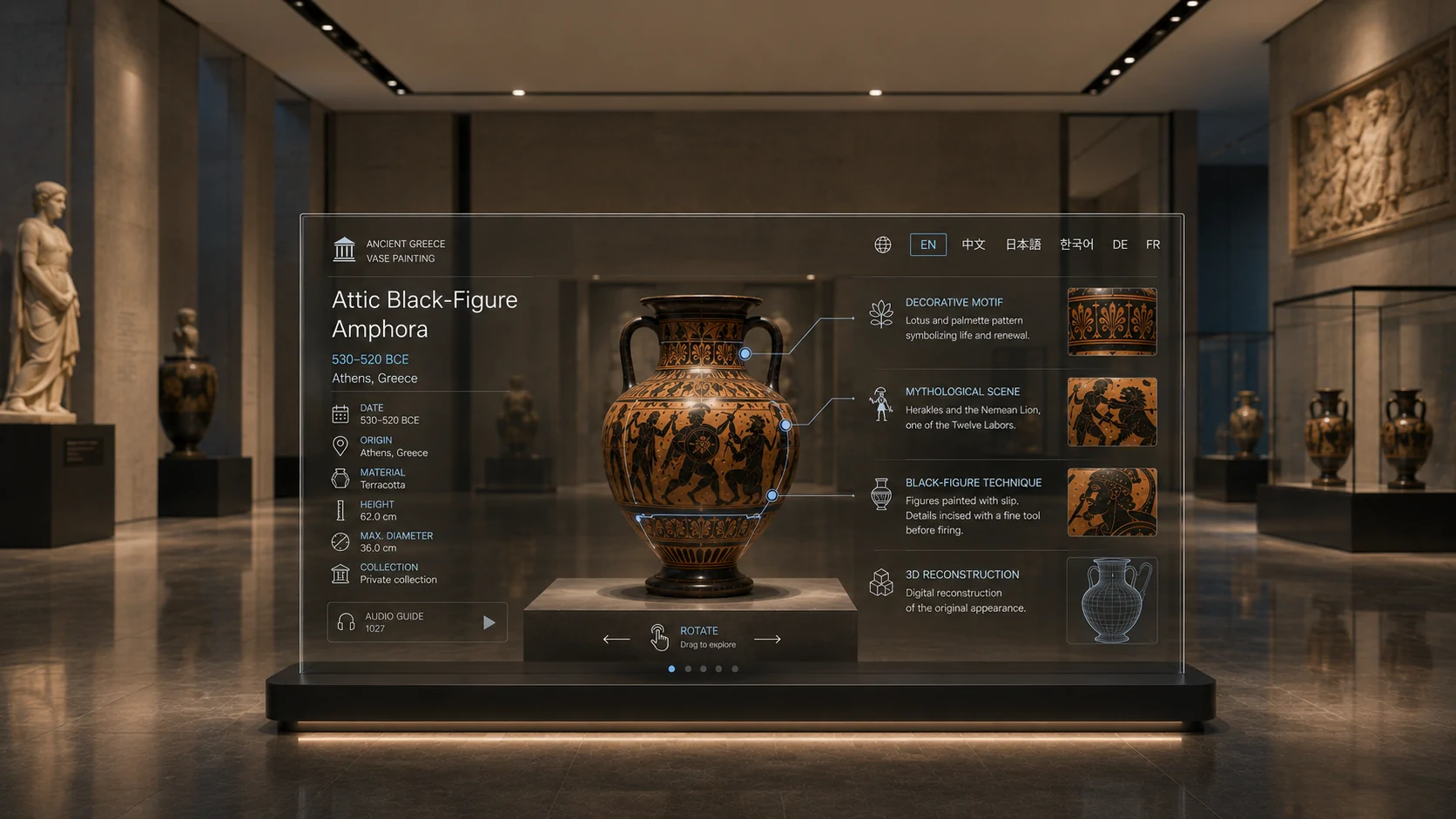
Spatial Display Packages
Choose product supply, a showcase or partition package, an interactive system or production delivery.
Transparent OLED Product Supply
30-inch, 55-inch and 77-inch commercial products selected for the installation scale and interaction model. A 77-inch consumer television route is reviewed separately.
Showcase or Partition Package
Display, glass, mounting, controller, power and cable routing coordinated for the built environment.
Interactive Display System
Touch, sensors, readers, playback and content interfaces integrated with the physical scene.
Prototype and Production Delivery
Viewing tests, approved drawings, controlled configuration and delivery documentation for the finished system.
Transparent OLED Advantages
Keep physical objects, architecture and human interaction visible while adding a responsive digital layer.
Interpretation
Museum artifact, collection object or physical model remains visible behind the digital content.
Hospitality
Restaurant menu or guest information is presented while the view into the space remains open.
Openness
Office, lounge, hotel or architectural partition retains visual connection between spaces.
Interaction
Touch, IR, vision sensor, NFC, barcode or external data can connect the physical scene to digital content.
Applications
See how transparent OLED supports museum, retail, hospitality, office and information environments.
Museum object interpretation
Digital labels and visual layers are registered to an artifact, model or collection object.
Restaurant menu display
Menu content is presented across a transparent surface while the kitchen or service interaction remains visible.
Retail product showcase
Product details and motion graphics are composed around merchandise, lighting and customer movement.
Office glass media partition
Shared information is added to glazing while daylight, openness and room-to-room visibility are retained.
Interactive information kiosk
Touch, sensors, accessibility and privacy are resolved with the enclosure and public workflow.
Refrigerated retail door
Product visibility, temperature, door operation and content scheduling are coordinated.
Hospitality and visitor-information display
Guest information supports service while preserving the visual character of the space.
Temporary spatial installation
Portable structure, setup time, content synchronization, power and safe access define the installation.
Background Options
Open background
Preserves the widest view, with readability dependent on the real scene and ambient light.
Designed object or background
Uses controlled color, material and object placement to support content contrast.
Dark backing
Raises perceived contrast where the installation can accept a less open appearance.
Electric shutter
Switches between an open view and a controlled backing when the operating sequence requires both.
PDLC layer
Adds a switchable diffusing state that must be reviewed with glazing, power and display-off behavior.
Local lighting
Shapes the object and rear scene while controlling reflections across the display content.
Interaction Architecture
Interaction path
Supporting interfaces